Eggy Swarm Development Update – Difficulty Progression, Permanent Upgrades & Cosmetic Stats
A fairly substantial progression update has now gone into Eggy Swarm, covering difficulty balance, unlock progression, permanent character power and a new gameplay-stat layer for cosmetics.
Normal difficulty has been made less punishing
One of the biggest changes is to
Normal difficulty.
Normal is intended to be the entry point into Eggy Swarm, so it has now been rebalanced to give players much more room to learn the game, build weapons and get used to boss mechanics before moving into the harder difficulties.
The current Normal defaults are approximately
75% enemy health, 65% enemy damage, 85% enemy movement speed, 25% normal spawn pressure and 25% elite pressure, with a much slower difficulty ramp. Score and credit rewards remain at the normal 1× baseline.
The intention is that Normal should still require you to build properly and survive, but it should no longer feel as though the game is trying to flatten a new player immediately.
Difficulty progression
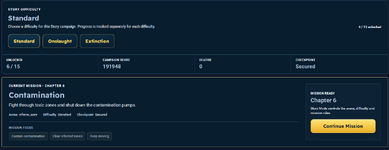
There are currently five main difficulties:
Normal is the starting difficulty and the most forgiving. It is designed for learning the arenas, weapons, evolutions and bosses.
Veteran is the first unlocked difficulty. Enemies become tougher and faster, spawn pressure increases and elites become more threatening. It currently gives a
1.25× score multiplier and 1.20× reward multiplier.
Nightmare pushes much harder, with substantially more enemy health, damage and elite pressure. It currently gives
1.55× score and 1.45× rewards.
Hell is intended to be genuinely punishing. Enemy health is around 1.9× Normal's baseline, damage 1.6×, spawning is much more aggressive and elites are significantly stronger. It provides
1.95× score and 1.75× rewards.
Swarm is currently the highest standard difficulty. Enemy health reaches
2.4×, damage
1.9×, spawn pressure
1.7× and elite pressure
2.5×, with
2.5× score and 2.2× rewards.
How higher difficulties are unlocked
Difficulty progression is now tied to actually beating the previous difficulty in
Classic mode.
Everyone starts with Normal available. Completing a Classic run on Normal unlocks Veteran. Completing Veteran unlocks Nightmare. Completing Nightmare unlocks Hell, and completing Hell unlocks Swarm.
So, for example, if you complete an arena on
Classic / Normal, Veteran becomes available for future Classic runs.
The unlock is based on a genuine Classic victory rather than simply surviving for a certain amount of time or reaching a score threshold. The game records the highest difficulty you have beaten and unlocks the next difficulty in sequence.
The win condition is the same on every difficulty
The objective itself does
not change between difficulties.
Whether you are playing Normal, Veteran, Nightmare, Hell or Swarm, a successful Swarm run requires you to:
Defeat all 3 bosses.
The difficulty changes how dangerous the journey becomes; it does not change what counts as winning.
That means players always know exactly what the objective is: survive the arena, develop your build, defeat all three bosses and complete the Swarm.
Permanent Progression has been substantially expanded
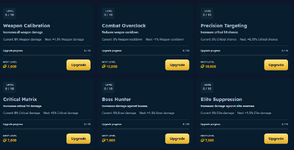
Permanent Progression has also grown into a much larger system.
There are now
19 permanent upgrades with 183 total ranks available. These upgrades carry into future standard runs and allow players to gradually specialise their account with offensive, defensive, utility and economy improvements.
Current Eggy defaults are:
- Weapon Calibration – Damage: +1.5% total weapon damage per rank. 10 ranks. Costs: 7,000 / 11,000 / 17,000 / 25,000 / 36,000 / 50,000 / 70,000 / 95,000 / 125,000 / 165,000 credits.
- Combat Overclock – Cooldown: -1% weapon cooldown per rank. 10 ranks. Costs: 10,000 / 16,000 / 24,000 / 35,000 / 50,000 / 70,000 / 95,000 / 130,000 / 175,000 / 230,000.
- Precision Targeting – Critical Chance: +0.75 percentage points critical chance per rank. 10 ranks. Uses the 10,000 → 230,000 premium cost curve.
- Critical Matrix – Critical Damage: +2% critical damage per rank. 10 ranks. Uses the 7,000 → 165,000 combat cost curve.
- Boss Hunter – Boss Damage: +1.5% damage against bosses per rank. 10 ranks. Combat cost curve.
- Elite Suppression – Elite Damage: +1.5% damage against elite enemies per rank. 10 ranks. Combat cost curve.
- Vitality Matrix – Maximum HP: +2% maximum HP per rank. 10 ranks. Combat cost curve.
- Reinforced Chassis – Armour: adds 1 Armour every two ranks, reaching +5 Armour at Rank 10. Combat cost curve.
- Recovery Nanites – Regeneration: +0.15 HP/sec regeneration per rank, reaching +1.5 HP/sec at Rank 10. Utility costs: 5,000 / 8,000 / 12,000 / 18,000 / 26,000 / 38,000 / 52,000 / 70,000 / 95,000 / 125,000.
- Hazard Plating – Hazard Resistance: -2% arena hazard damage per rank. 10 ranks. Utility cost curve.
- Velocity Calibration – Projectile Speed: +2% projectile speed per rank. 10 ranks. Utility cost curve.
- Area Engineering – Weapon Area: +1.5% weapon area/radius per rank. 10 ranks. Utility cost curve.
- Thruster Calibration – Movement Speed: +1.5% movement speed per rank. 10 ranks. Utility cost curve.
- Magnet Array – Pickup Radius: +5% pickup radius per rank. 10 ranks. Utility cost curve.
- Experience Uplink – XP Gain: +2% XP gain per rank. 10 ranks. Utility cost curve.
- Flux Stabilisation – Duration: +1.5% weapon/effect duration per rank. 10 ranks. Utility cost curve.
- Tactical Rerolls: +1 starting reroll per rank, up to 3. Costs 25,000 / 75,000 / 200,000 credits.
- Fortune Processor – Luck: +1% Luck per rank. 10 ranks. Premium cost curve.
- Salvage Protocol – Run Credits: +1% credits from accepted eligible runs per rank. 10 ranks. Premium cost curve.
The default progression catalogue therefore represents
10,838,000 credits worth of permanent progression if somebody eventually maxes everything.
This system is deliberately long-term. It gives credits somewhere meaningful to go without requiring players to abandon the weapons, characters or cosmetics they already enjoy.

Cosmetics can now provide gameplay stats
Cosmetics are no longer necessarily visual-only.
Eligible cosmetics can now carry curated stat packages, and those bonuses are displayed directly on their Swarm Shop cards before purchase.
The supported stat types currently include
Damage, Cooldown Reduction, Critical Chance, Critical Damage, Boss Damage, Elite Damage, Maximum HP, Armour, HP Regeneration, Hazard Resistance, Projectile Speed, Weapon Area, Movement Speed, Pickup Radius, XP Gain, Effect Duration, Luck and additional Run Credits.
Different cosmetic categories can lean toward different kinds of bonuses. For example, weapon finishes naturally suit offensive bonuses, character skins can lean defensive, while trails, auras, profile items and other cosmetic categories can provide utility or progression-oriented bonuses.
There are also combined-equipment caps so somebody cannot simply stack an unlimited amount of one stat by equipping several cosmetics.
The current default combined cosmetic caps include things such as
+6% Damage, -4% Cooldown, +3% Critical Chance, +10% Critical Damage, +6% Boss Damage, +6% Elite Damage, +8% Max HP, +3 Armour, +0.60 HP/sec Regen, -8% Hazard Damage, +8% Projectile Speed, +6% Weapon Area, +6% Movement Speed, +20% Pickup Radius, +8% XP Gain, +6% Duration, +4% Luck and +4% Run Credits.
Permanent Progression and cosmetic bonuses also stack together, so they form two separate layers of long-term character development rather than replacing one another.
Site owners now control both systems from the ACP
An important part of this work is that I did
not want Eggy Swarm's progression balance permanently dictated by my preferred numbers.
Both systems are now designed to be configurable by the site administrator from the XenForo ACP.
Permanent Progression Tuning allows the administrator to change the credit cost and total effect of
every individual rank of every permanent upgrade.
That means a site could keep the Eggy defaults, make progression slower and more conservative, or deliberately create a much more powerful arcade-style version of Swarm.
For example, if an upgrade normally starts at
+5% Damage, the site administrator could decide that on their community it should be
+50% Damage instead. The gameplay runtime uses the administrator-defined value rather than relying on a hardcoded client-side percentage.
The costs work the same way. Rank 1 could cost 5,000 credits on one site and 100,000 on another, while later levels can each have their own independently configured price and effect.
Existing players
keep the ranks they have already purchased when these values are changed.
Cosmetic Stat Tuning provides the same level of control for cosmetics. Administrators can edit the exact bonuses attached to individual cosmetics and can also adjust the global stacking caps.
So a cosmetic that ships with something like
+0.7% Damage could be changed to
+2%, +5%, +20% or whatever the site owner considers suitable for their own economy and balance.
The goal is for Eggy Swarm to ship with a balanced default experience while still giving communities full control over how grindy, generous, difficult or overpowered they want their own version of the game to become.
There is still plenty more planned, but this update puts a much stronger progression framework underneath the game and gives both players and site owners significantly more control over how Eggy Swarm develops.